

"We cannot afford to lose our local media" – Paul Davies MS challenges Welsh Government as nearly 300 local newspapers disappear across UK
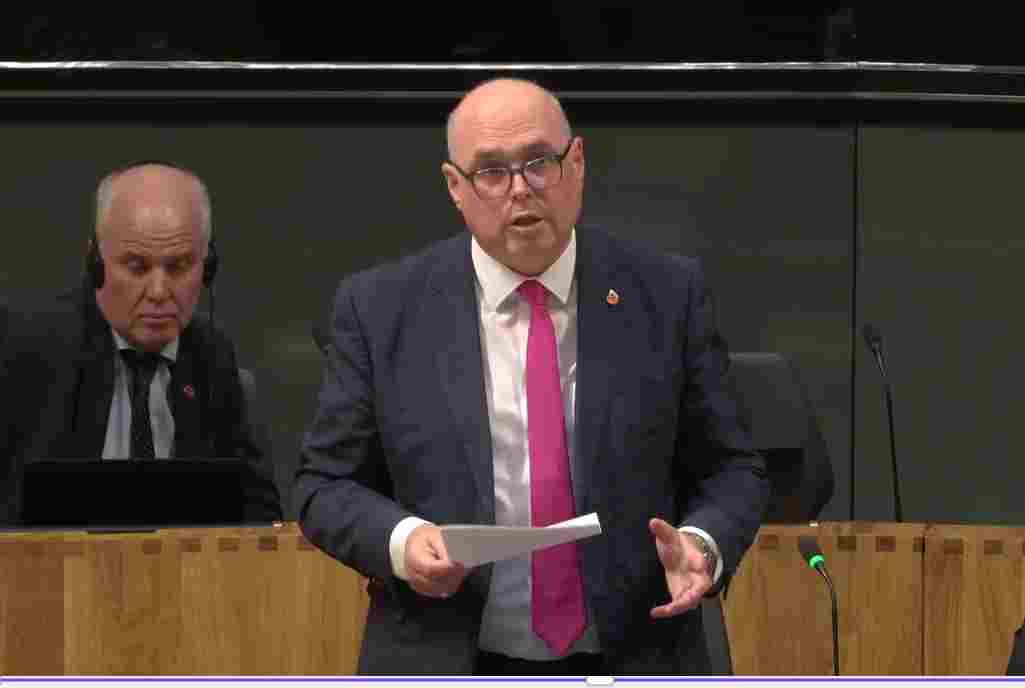
Paul Davies MS has called for urgent action to safeguard local journalism and community broadcasting, warning that the loss of trusted local news outlets risks leaving rural communities without a voice.
The Member of the Senedd for Ceredigion Penfro raised his concerns during a Senedd Statement by the Cabinet Minister for Culture & Sport on The Future of Media in Wales on Tuesday 3 November, challenging the Welsh Government over what practical support it intends to provide to help struggling local newspapers, independent journalists and community radio stations survive and thrive.
His intervention comes against a backdrop of mounting financial pressures across the industry.
According to the UK Government's Local Media Action Plan, published in March 2026, at least 293 local newspapers have closed across the UK since 2005, equivalent to around a third of the sector.
The same report revealed that advertising revenue for local news publishers fell from £1.68 billion in 2011 to just £330 million in 2024, illustrating the scale of the financial challenge facing traditional journalism.
During the debate, Mr Davies questioned the Cabinet Minister for Culture and Sport Heledd Fychan about the Welsh Government's plans for the media sector, arguing that greater attention must be given to the future of hyperlocal journalism and community broadcasting.
He expressed disappointment that the Government's statement had not provided more detail about how local media organisations would be supported, particularly those serving rural communities.
Mr Davies also questioned the impact of social media on news consumption, the ongoing BBC Charter review and the need to protect Welsh-language broadcasting.
Paul Davies MS said:
"Where would our communities be without our local newspapers, journalists and community radio stations?
"These are the people telling our stories, celebrating our successes, championing local causes and, importantly, asking the difficult questions that need to be asked.
"They give our communities a voice, and that is something we simply cannot afford to lose.
"Across Ceredigion Penfro, we are incredibly fortunate to have dedicated local newspapers, independent journalists and community broadcasters who work tirelessly to keep people informed and connected.
"I want to pay tribute to every single one of them. I know how hard they work, often with very limited resources, and I genuinely value the enormous contribution they make.
"But these latest figures should serve as a wake-up call. When almost 300 local newspapers have disappeared across the UK, we simply cannot take the future of our own local media for granted."
The challenges facing local journalism extend beyond newspaper closures.
Research published by King's College London in August 2026, examining 27 local newspapers between 2019 and 2025, found that the proportion of original content had fallen from 79.7% to 56.5%, while specifically local coverage had declined from 66.5% to 51.5%.
Mr Davies warned that the consequences of declining local journalism could be particularly significant for rural areas such as Ceredigion and Pembrokeshire, where trusted local reporting plays an essential role in connecting dispersed communities.
He continued:
"Local journalism is about so much more than reporting the news. It's about shining a light on the decisions being made in our communities, holding public bodies to account and making sure that local people have their voices heard.
"Whether it's reporting on pressures facing our hospitals, highlighting concerns about local services, celebrating community achievements or supporting local campaigns, our newspapers and broadcasters provide an invaluable public service.
"And in rural areas like ours, where communities are spread across large geographical distances, that local connection is especially important.
"This isn't simply about protecting newspapers and radio stations. It's about safeguarding jobs, supporting creative talent, celebrating our Welsh identity and ensuring that the issues affecting rural communities are not overlooked."
Responding to Mr Davies in the Senedd, Cabinet Minister Heledd Fychan agreed with his assessment of the importance of local media to the economy and community cohesion.
The Minister acknowledged the challenges facing the sector and highlighted the Welsh Government's proposals for a shadow broadcasting and communications authority, alongside existing support for journalism.
However, Mr Davies questioned whether establishing new structures represented the best use of public money, arguing that the priority should be strengthening existing initiatives, supporting innovation and working more closely with the UK Government to secure investment.
Mr Davies added:
"While the way we consume news is changing rapidly, the need for trusted, independent journalism has never been greater.
"Social media has transformed how people access information, but it cannot replace the scrutiny, professionalism and accountability that good local journalism provides.
"I want to see the Welsh Government working directly with local publishers, journalists and community broadcasters to understand the pressures they face and identify practical ways to help them build a sustainable future.
"We should be focusing on supporting what works, encouraging innovation and ensuring that our home-grown media businesses can continue to grow and adapt in the digital age.
"Warm words alone will not secure the future of local journalism. We need meaningful action to ensure that the next generation of journalists can continue telling the stories that matter to our communities.
"A strong local media means stronger, better-informed communities, and I will continue to champion the people and organisations who work so hard to give our communities a voice."