

"We Call It What It Is": First Minister and Deputy First Minister of Wales Declare Israel's Actions in Gaza Amount to Genocide.
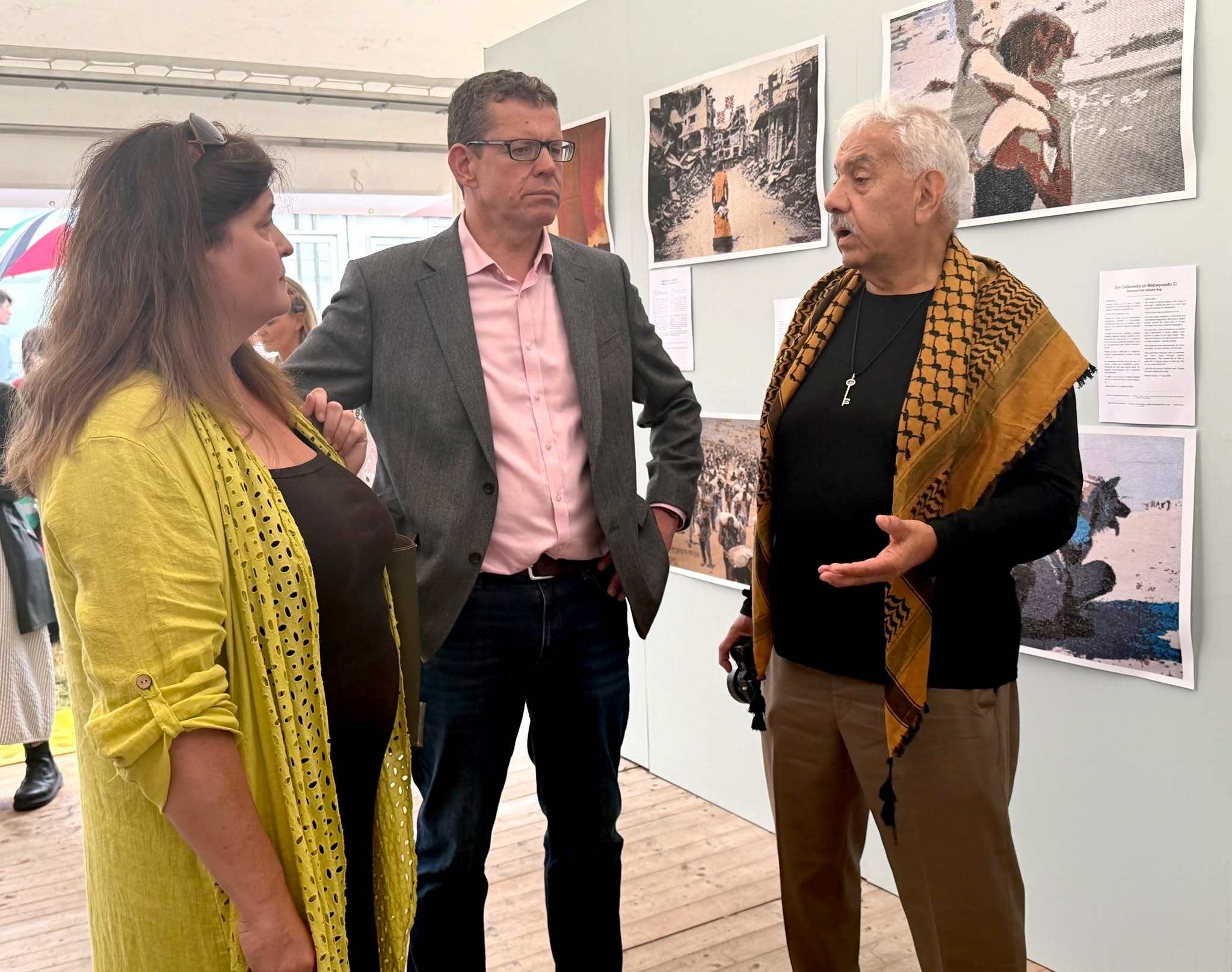
In what campaigners have described as a watershed moment, the newly elected First Minister, Rhun ap Iorwerth, and Deputy First Minister, Sioned Williams, publicly stated in speeches at the National Eisteddfod that Israel's actions in Gaza amount to genocide.
The declaration came at the opening of the Gaza Genocide Tapestry — a devastating and beautiful exhibition of images of hand-stitched tapestries, on the PSC stand at the National Eisteddfod, Wales' largest festival. Together with Palestinian curator Faisal Saleh, the two leaders viewed the exhibition, which documents a devastated Gaza and the resilience of its people.
"We call out the genocide for what it is," said First Minister Rhun ap Iorwerth. "Wales was one of the first parliaments to call for a ceasefire. There are lots of people in Wales who share our revulsion at what is happening in Gaza, and as politicians, we give voice to those feelings."
Deputy First Minister Sioned Williams: "It was frustrating in opposition, and now in government, to be told that we do not have a voice in foreign affairs. But we do have a voice to call out the genocide. There are people on the streets of Wales every week demonstrating their revulsion at the actions in Gaza, and we reflect those voices as the government of Wales."
It is one of the strongest statements yet from a devolved UK government on Gaza — and it places Wales alongside a growing list of world leaders and institutions now naming what campaigners have called for nearly three years: genocide.
The tapestry itself is testimony stitched by hand. Created by Palestinian women embroiderers in refugee camps across the West Bank, Lebanon and Jordan, each panel is worked in tatreez — the centuries-old Palestinian art of embroidery, turned here into an act of memory and resistance.
"Every stitch becomes a gesture of memory, resilience, and a request for accountability," said Faisal Saleh, Executive Director of the Palestine Museum US and curator of the exhibition. "One of our aims was to show the consequences of silence and complicity. I have been deeply impressed by the extraordinary solidarity shown by the people of Wales, and by the global leadership demonstrated by the First Minister and Deputy First Minister. During one of the darkest chapters in our history, that solidarity means more than words can express."
Bethan Sayed of PSC Cymru said the statement was long overdue — and long fought for:
"We warmly welcome the decision of the First Minister and Deputy First Minister to describe the Israeli government's actions in Gaza as genocide. At a time when too many political leaders continue to avoid confronting the reality of what Palestinians are enduring, their willingness to speak with clarity reflects both moral courage and leadership.
"The people of Wales have stood in solidarity with Palestine week after week for almost three years. Communities across the country have marched, campaigned and demanded that international law be upheld. These statements demonstrate that those voices have been heard.
"History will remember those who chose to remain silent, and it will remember those who stood up for justice. We hope the Welsh Government will now translate these words into action — by pursuing every opportunity available to Wales to uphold international law and support accountability."
The exhibition has become a popular stall at this year's National Eisteddfod — a space where visitors confront both the devastating human cost of the war in Gaza and the unbroken resilience of the Palestinian people.
Pic cap: Faisal Saleh, founder of Palestine Museum, discusses genocide with First Minister Rhun ap Iorwerth and Deputy First Minister Sioned Williams. Photo by David Nicholson.